Table of Contents
How hybrid cloud and generative AI are redefining modern security operations
As physical security environments continue to expand in scale and complexity, organizations are under increasing pressure to do more with less – more sites, more data and more threats, all while operating with leaner teams and tighter budgets.
According to recent market analysis from "IDC InfoBrief, sponsored by VIVOTEK," the industry has reached a pivotal inflection point. Security leaders are moving away from incremental hardware upgrades and toward platforms that deliver operational efficiency, system unification and AI-driven intelligence.
A core driver behind this shift is the rise of unified cloud platforms that bring cameras, access control, smart sensors and AI-powered analytics into one centrally managed environment, eliminating the operational fragmentation that has long slowed decision-making. The message is clear: modern security operations demand platforms, not disconnected point solutions.
This shift is accelerating adoption of hybrid cloud architectures and unified AI intelligence, thus enabling organizations to modernize without disruption while improving response times, strengthening governance and lowering total cost of ownership.
The technology shift: Balancing control and scalability
Hybrid cloud has emerged as a critical enabler for AI-driven physical security. Enterprises increasingly seek architectures that combine the compliance and control of on-premise systems with the scalability and efficiency of cloud platforms. Digital-native organizations are leading this shift, recognizing hybrid deployments as essential for predictable cost management, stronger governance and global operational resilience.
Hybrid architectures deliver clear advantages. Sensitive data can remain under enterprise control to meet regulatory and audit requirements, while AI applications positioned closer to the source reduce latency and enable faster response. At the same time, flexible failover between cloud and dedicated systems improves resilience and helps avoid costly downtime.
IDC research reflects this balance in AI deployment preferences. While public cloud flexibility remains important, many organizations place equal or greater value on the ability to deploy AI models across both cloud and dedicated environments, underscoring the growing role of hybrid platforms in enterprise security strategies.
VORTEX: Unified cloud, hybrid scalability and total simplicity
VIVOTEK’s VORTEX was designed to meet these evolving requirements.IDC analysis consistently highlights platform consolidation as a top priority, as security teams struggle with fragmented tools for video, access control, sensors and analytics. VORTEX resolves this challenge by delivering a unified cloud platform where all security systems are managed through a single interface.
This centralized visibility enables teams to monitor multiple sites, investigate incidents and take action without switching systems or workflows. Low-bandwidth background connectivity ensures reliable operations, even in constrained network environments.
Just as important, VORTEX supports hybrid scalability. Organizations can deploy VORTEX direct-to-cloud cameras or connect to an existing infrastructure, helping to extend the life of current investments while unlocking advanced cloud and AI capabilities.
At the operator level, VORTEX emphasizes total simplicity. An intuitive interface, deep forensic search and generative AI alerts dramatically reduce investigation time and operator workload. Real-time notifications and webhook integrations further automate response workflows, allowing teams to do more with fewer resources.
AI at the edge: From smart devices to autonomous decision-making
AI is no longer a future differentiator, it is a present-day operational requirement. IDC research shows that organizations are prioritizing both cost reduction and extending AI capabilities to the edge, where intelligence can be applied closer to the source.
VORTEX delivers unified AI intelligence across both the edge and the cloud. Edge AI processes data locally to reduce, improve reliability and filter routine events and false alarms – lowering costs and allowing teams to focus on real risks.
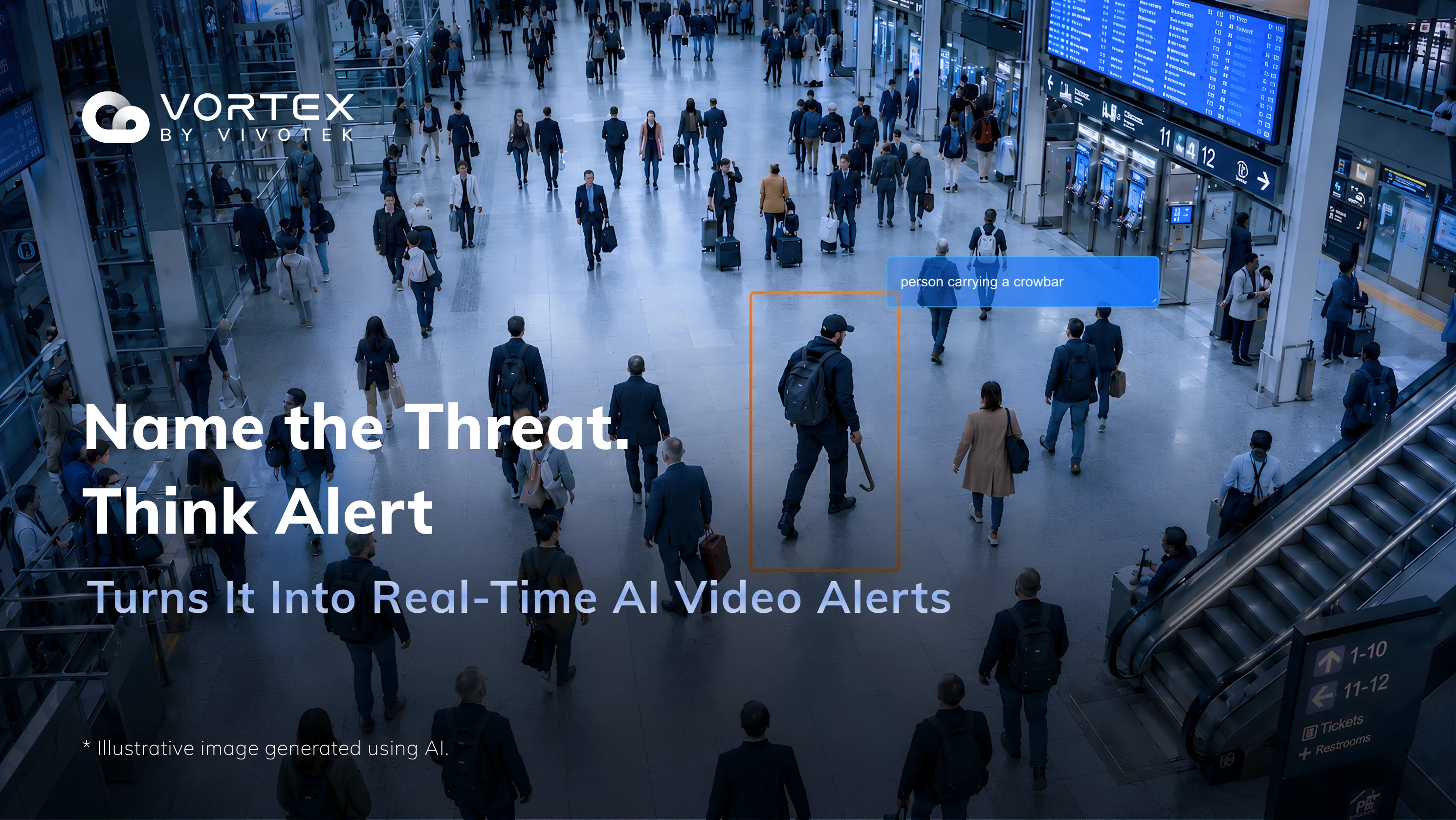
This shift transforms devices from passive sensors into autonomous decision-makers. For example, edge AI can distinguish harmless incidents, such as a blocked emergency exit, from a real threat in real time. The result is higher accuracy, fewer unnecessary escalations and reduced operational disruption, while maintaining immediate response when it matters most.
Cloud and generative AI further enhance situational awareness. Natural-language search powered by VLM allows operators to find events simply by describing them, while AI-driven alerts help prioritize critical incidents. Together, edge and cloud AI operate as a single intelligence layer within one unified workflow.
Building beyond surveillance: An open platform for growth
Another key IDC insight is the growing demand for open ecosystems. Security platforms must extend beyond video to support broader safety and operational use cases. VORTEX is built with this flexibility at its core.
VORTEX is built as an open platform, integrating access control, smart sensors and third-party applications through APIs and RTSP streaming. This openness enables customized workflows, advanced analytics and seamless interoperability across diverse environments.
Beyond fixed infrastructure, this open architecture also enables the integration of robots and drones as mobile and autonomous intelligence endpoints. Video footage, sensor data and AI-generated events from robotic patrols or aerial inspections can be centrally managed and correlated with cameras, access control and IoT sensors within the same VORTEX workflow.
This openness transforms VORTEX from a video platform into a foundation for scalable operational intelligence, supporting future expansion without disrupting existing operations.
The future outlook: Driving operational automation
AI-powered operational automation is emerging as the next evolution in physical security. Seamless integration with IoT devices and smart infrastructure, combined with advances in AI-enhanced cloud surveillance, is enabling a shift from passive monitoring to proactive response.
Multimodal AI, combining video, language, sound and environmental data, unlocks new capabilities including context-aware alerts, multisensory event detection and holistic situational awareness. These innovations reduce risk exposure, support continuity during high-traffic conditions and enable intelligent resource allocation based on real-time insights.
Meeting Today’s Needs and Tomorrow’s Expectations
IDC’s analysis makes it clear: the future of physical security is unified, intelligent, and disruption-free. VORTEX brings this vision to life with unified cloud, hybrid scalability, and total simplicity—built for today’s operations and tomorrow’s demands— enabling efficient operations today and readiness for future demands.
Download the IDC Infobrief to discover how modern video surveillance is evolving into a strategic business enabler. From Edge AI to hybrid cloud, see how top organizations are rethinking security for measurable impact. To watch VIVOTEK’s latest webinar on demand, please click here.
*Source From: IDC InfoBrief, From Devices to Decisions: AI at the Edge. Power in the Cloud. Security Everywhere.(Doc #AP242533IB), sponsored by VIVOTEK Inc., September 2025.
The article originally featured on Security Journal Americas