Table of Contents
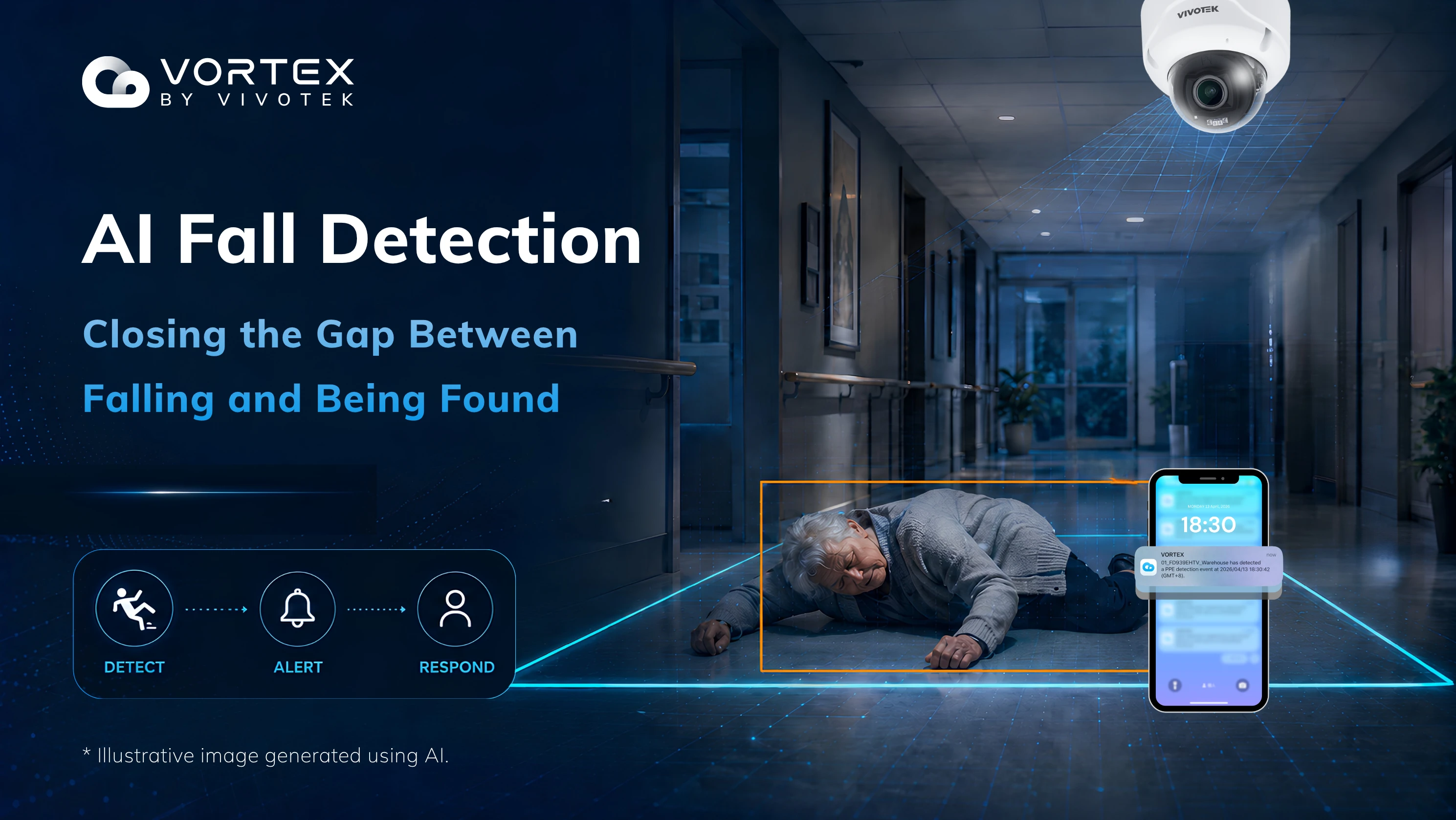
A fall becomes an emergency when no one sees it.
Why Real-Time Fall Detection Matters
The gap between a fall occurring and the person being found can determine how quickly help arrives. Imagine it is 2 a.m. in a care facility: a resident loses their balance in the corridor and goes down. They are not seriously injured by the fall itself, but they cannot get back up, and no one is in the corridor to see them. What happens next comes down to a single number: how many minutes pass before someone responds. The same response gap exists in warehouses, schools, stairwells, and lone-worker environments, where incidents often occur outside direct supervision.
A person slips, trips, or collapses. If they cannot get back up because they are injured, unconscious, or alone, response time becomes critical. Traditional CCTV systems are designed to record incidents, not to react to them in real time, and manual patrols cannot continuously monitor every corridor, stairwell, pool edge, or warehouse aisle. As a result, a gap often exists between the moment someone falls and the moment help arrives, and the cost of that gap is well documented. In studies of older adults, “long-lie” incidents, in which a person remains on the floor for more than an hour after a fall, have been associated with significantly worse outcomes, including high six-month mortality rates. ¹
Common Fall Risk Scenarios Across Facilities
-
Recreation areas: A delayed response near water can quickly turn life-threatening, especially when a person falls, collapses, or is unable to call for help. In emergencies such as sudden cardiac arrest, every minute of delay can significantly reduce the chance of survival.²
-
Warehouses and industrial facilities: Lone workers may collapse in aisles, loading zones, or low-visibility areas where supervision is limited, leaving incidents undiscovered. Research on fall incidents shows³ that the majority of falls occur when the person is alone, precisely the situation commonly faced by lone workers. Real-time fall detection supports workplace safety monitoring by helping teams identify incidents sooner, before they go undiscovered for extended periods.
-
Schools and educational campuses: Falls in stairwells, hallways, gyms, or low-supervision areas may go unnoticed between class periods, during activities, or after hours.
-
Properties and multi-site facilities: Falls can occur in parking lots, lobbies, service corridors, stairwells, or outdoor walkways, where staff cannot continuously monitor every area. AI fall detection helps facility teams improve visibility across distributed locations and coordinate response through a centralized workflow.
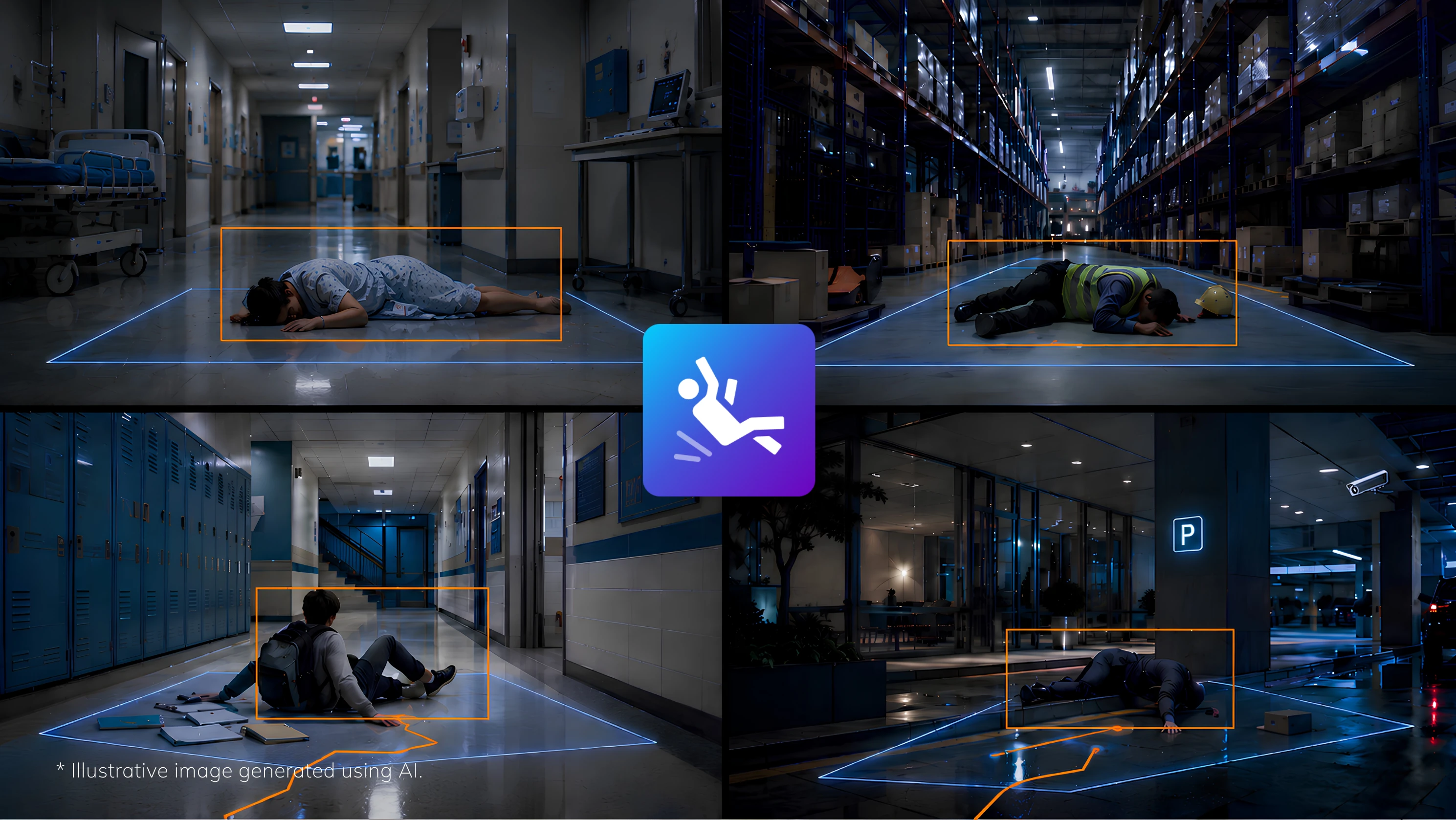
These are not isolated incidents. They are common operational gaps created by monitoring systems that were never designed for real-time response. Traditional recording-only systems can document what happened after the fact, but they cannot help organizations respond while every minute still matters.
How VORTEX Fall Detection Turns Detection Into Response
VORTEX Fall Detection transforms surveillance from passive recording into an active safety workflow:
Detect → Action → Reporting.
Detect: Identify Fall Events in Real Time
VORTEX Fall Detection identifies when a person has fallen and remains on the ground in real-world environments such as pools, corridors, warehouses, and public facilities. Unlike manual patrols or periodic supervision, the system continuously monitors connected cameras without fatigue or gaps between rounds. To reduce unnecessary alerts, it uses a short confirmation window to verify whether the person stands up independently before triggering an event, distinguishing genuine falls from crouching, sitting, or brief movements. As an AI-powered service, Fall Detection runs on VORTEX's supported camera models, which are listed at the end of this article.
Action: Trigger Automated Response Workflows
Detecting a fall is meaningful only when action follows immediately. When a fall triggers an event, VORTEX Alarm Management automatically executes a response that you have configured in advance, without waiting for a person to verify the clip first.
▍ Response actions include:
-
App and email notifications: Instantly notify duty staff, nurse stations, supervisors, or security personnel when a fall event is detected.
-
Speaker broadcasts: Activate on-site IP speakers to play a pre-recorded message that directs nearby staff or bystanders to the location for an immediate check.
-
Webhook integrations: Send fall events directly to the platforms your team already uses, such as nurse-call systems, EHS platforms, incident-management systems, or building-management dashboards, so that VORTEX fits into your existing operations rather than replacing them.
The result is a closed loop: the fall is detected, the right people are notified, and help is on the way, all in one automatic sequence, while it still makes a difference. Because these workflows can be configured in advance, teams can standardize how fall events are handled without waiting for manual video verification.
Reporting: Investigation and Audit-Ready Evidence
Real-time alerting addresses the emergency in the moment. The reporting layer helps organizations manage accountability, investigations, and evidence after the fact. By following a notification into the AI Hub → Event Insight interface, administrators can filter events by event type (Fall), timestamp, device, and location.
With VORTEX Re-search, operators can investigate activity before and after a fall event across multiple cameras using facial or full-body search, helping them reconstruct incident timelines and strengthen operational visibility.
Using VORTEX Case Vault, administrators can gather relevant clips, add investigation notes, and export structured incident reports, the kind of documentation that administrators, insurers, regulators, and safety teams often require. This significantly reducing the time spent on manual footage review and report preparation.
For multi-site organizations such as care groups, school districts, or facility networks, fall event data can be consolidated and reviewed across locations through a centralized cloud workflow.

What You Need to Enable VORTEX Fall Detection
To use VORTEX Fall Detection, your VORTEX organization requires the following:
▍ An xStd or xPro connection license, along with the Advanced AI add-on license:
-
xStd supports real-time Fall Detection events and automated response workflows via Alarm Management.
-
xPro adds advanced investigation and evidence management features within AI Hub, including Re-search and Case Vault.
In short, xStd delivers real-time detection and automated response, while xPro extends the workflow with post-event investigation and evidence management.
▍ Supported VORTEX camera models:
-
Bullet: IB939-EHTV, IB839-EHTV-V2, IB833-HV
-
Dome: FD939-EHTV, FD839-EHTV-V2, FD833-HV
-
Turret: IT939-HTVW, IT839-HTVW-V2, IT833-HVW
From Recording Falls to Responding in Real Time
Traditional safety monitoring relies on manual patrols, periodic supervision, and after-the-fact video review. Patrols cannot scale to cover every corridor, stairwell, and blind aisle simultaneously, and a recording-only system contributes nothing in the seconds when help is needed most.
With VORTEX AI-based Fall Detection, help no longer waits for someone to notice. Fall events trigger immediate alerts and automated workflows, so unwatched areas remain covered, staff spend less time at monitors, and reports take minutes rather than hours. That is the shift VORTEX delivers: not a better camera, but the difference between a system that documents a fall and one that helps someone respond to it.

Tags