Table of Contents
What Is PPE Detection and How Does It Work
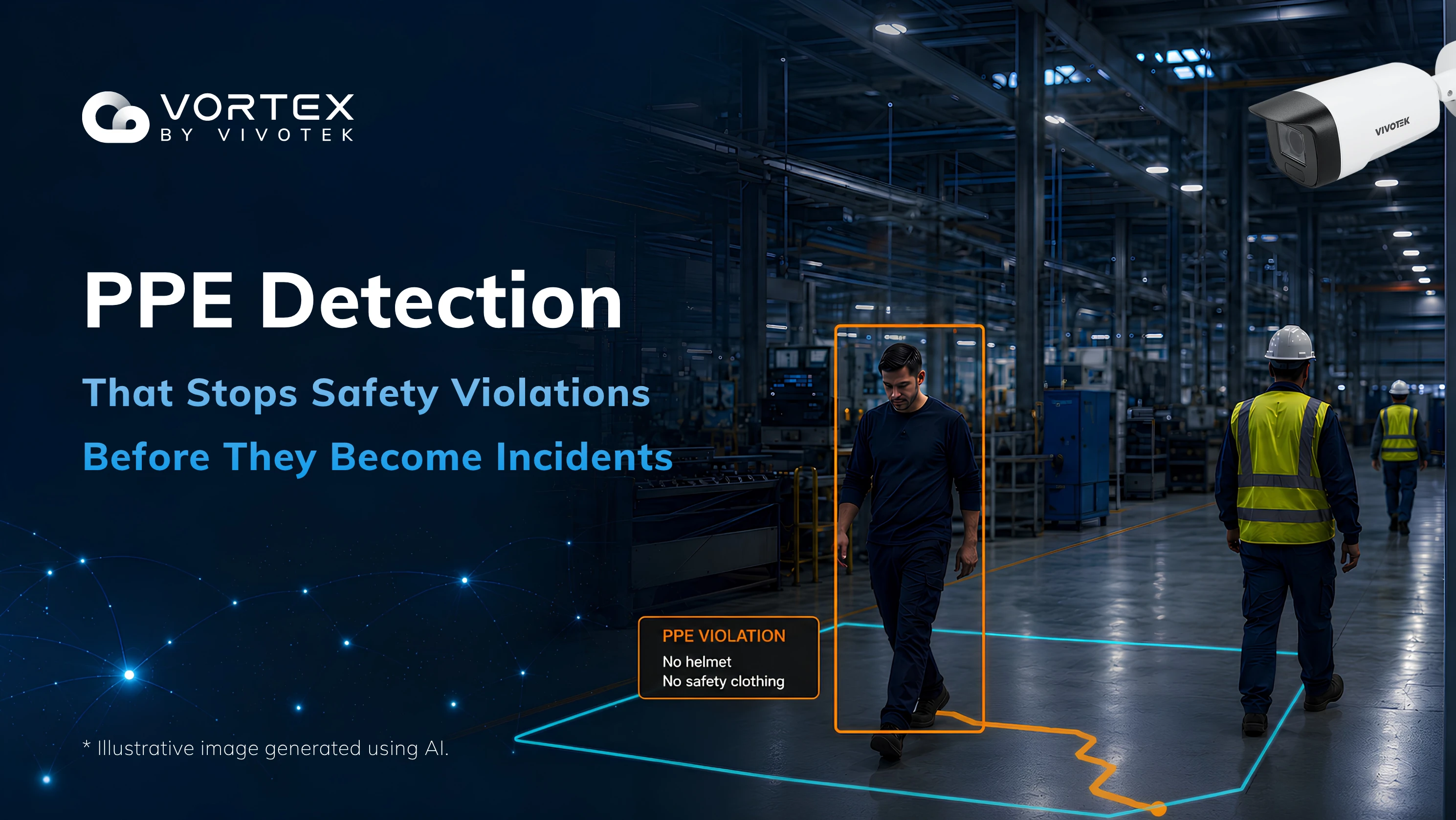
PPE detection uses AI video analytics to determine whether workers are wearing the required personal protective equipment, such as hard hats and high-visibility vests. The system continuously analyzes camera footage and flags potential PPE violations in real time.
Once a violation is detected, it can trigger alerts, speaker warnings, email notifications, or webhook integrations. This enables safety teams to respond faster and transforms PPE compliance from periodic inspections into an active workplace safety workflow.
The Real Problem: Compliance at the Gate Doesn't Reach the Floor
PPE policies may begin at the gate, but violations often occur on the floor. Hard hats come off during long shifts. High-visibility vests are removed for comfort or out of habit. Traditional surveillance systems typically capture incidents after they happen rather than helping prevent them in real time. Manual patrols, meanwhile, cannot monitor every area continuously, leaving gaps between violations and responses. Related regional PPE and workplace safety resources are provided at the end of this article.
▍ Common risks include:
-
Workers disappearing into forklift blind spots without high-visibility vests
-
Missing hard hats during overhead work
-
Delayed response to unsafe behavior
These are everyday operational risks that reactive surveillance alone cannot solve.
Why Recording Alone Is No Longer Enough for PPE Compliance
Workplace safety compliance expectations are rising worldwide. Regulators increasingly expect organizations not only to provide PPE, but also to prove that it was being worn and that they acted the moment a violation occurred.
▍ Organizations today face growing pressure from:
- Stricter workplace safety enforcement
- Rising financial penalties
- Insurance and audit requirements
- Operational accountability
Across industrial markets such as North America, Europe, Australia, and Japan, workplace safety expectations are evolving beyond simply providing PPE toward continuous enforcement, operational accountability, and real-time response across sites. Traditional recording-only systems leave organizations with delayed visibility and a limited ability to respond when violations occur.
VORTEX PPE Detection: From Passive Recording to an Active Safety Loop
VORTEX rebuilds PPE enforcement around the platform's core workflow:
Detect → Action → Reporting
This transforms surveillance from passive recording into real-time operational safety enforcement.
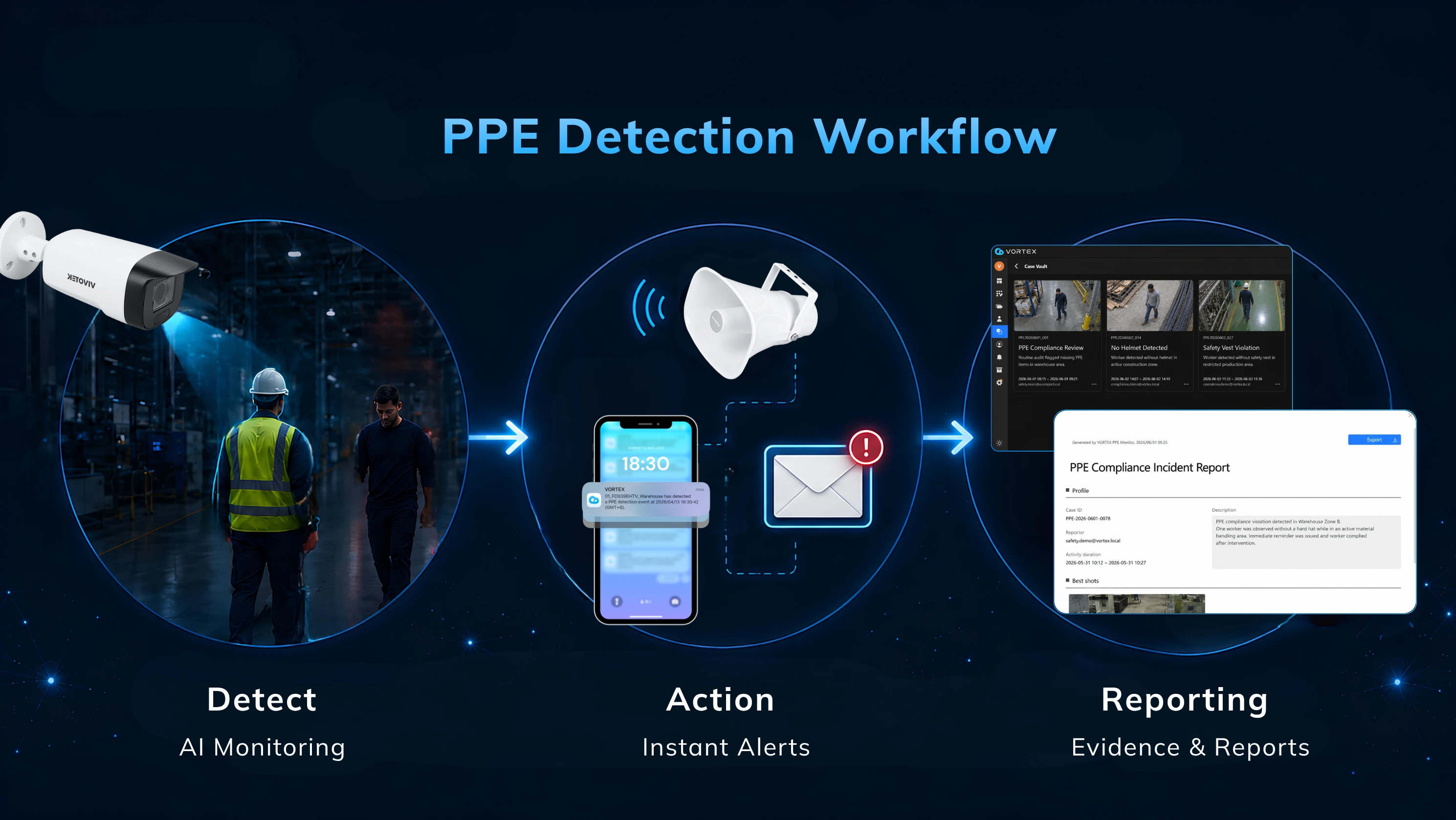
1. Detect: Continuous, AI-Based PPE Monitoring
VORTEX's PPE Detection model identifies whether workers are wearing hard hats and high-visibility vests. Unlike manual patrols or periodic spot checks, the system monitors every frame continuously, without fatigue or gaps between inspections.
As an AI-powered service, PPE Detection runs on supported VORTEX camera models. The current list of supported models is provided at the end of this article.
Real-time PPE Detection events are supported on both xStd and xPro connection licenses with the Advanced AI add-on license enabled.
2. Action: Immediate Automated Intervention
Detection has value only when something follows it. When a PPE violation triggers an event, VORTEX Alarm Management can automatically execute predefined responses in real time, without waiting for manual review:
- Speaker broadcasts: Connect on-site network speakers to play a pre-loaded audio warning that corrects the behavior on the spot, the moment it occurs.
- App and email notifications: Notify administrators when violations occur.
- Webhook integrations: Send violation events directly to a third-party system such as an EHS, incident management, or workflow platform. The event payload is posted to that system via HTTP as soon as a violation is triggered.
This event-driven workflow allows safety teams to integrate PPE monitoring into existing operational processes without requiring parallel manual logging.
In supported project environments, the same workflow can also integrate with access-control systems to help enforce restricted-area compliance procedures.
The result is a closed loop: the violation is caught, the worker is corrected, and your systems are notified—all in one automated sequence.
3. Reporting: Audit-Ready Investigation and Evidence Management
Real-time correction handles the immediate risk. The reporting layer handles accountability and proves your compliance when it counts.
Within the AI Hub → Event Insight interface, the workflow is built for rapid investigation. Filter by event type (PPE), timestamp, device, and location to find the events that matter. From there, organizations can:
- Build compliance reports faster: Using VORTEX Case Vault, administrators can collect relevant clips and event evidence, add notes and context, and export structured compliance reports. This significantly reduces the time typically required to manually review footage and compile documentation.
- Identify repeat violations: With VORTEX Re-Search, operators can investigate whether the same individual (matched by face or full body) has triggered PPE violations across multiple cameras or locations. This helps organizations identify repeat offenders, detect recurring unsafe behavior, and improve long-term safety enforcement visibility.
For multi-site organizations, PPE violation data can be consolidated across facilities through a centralized cloud workflow, creating a more scalable approach to compliance monitoring and reporting.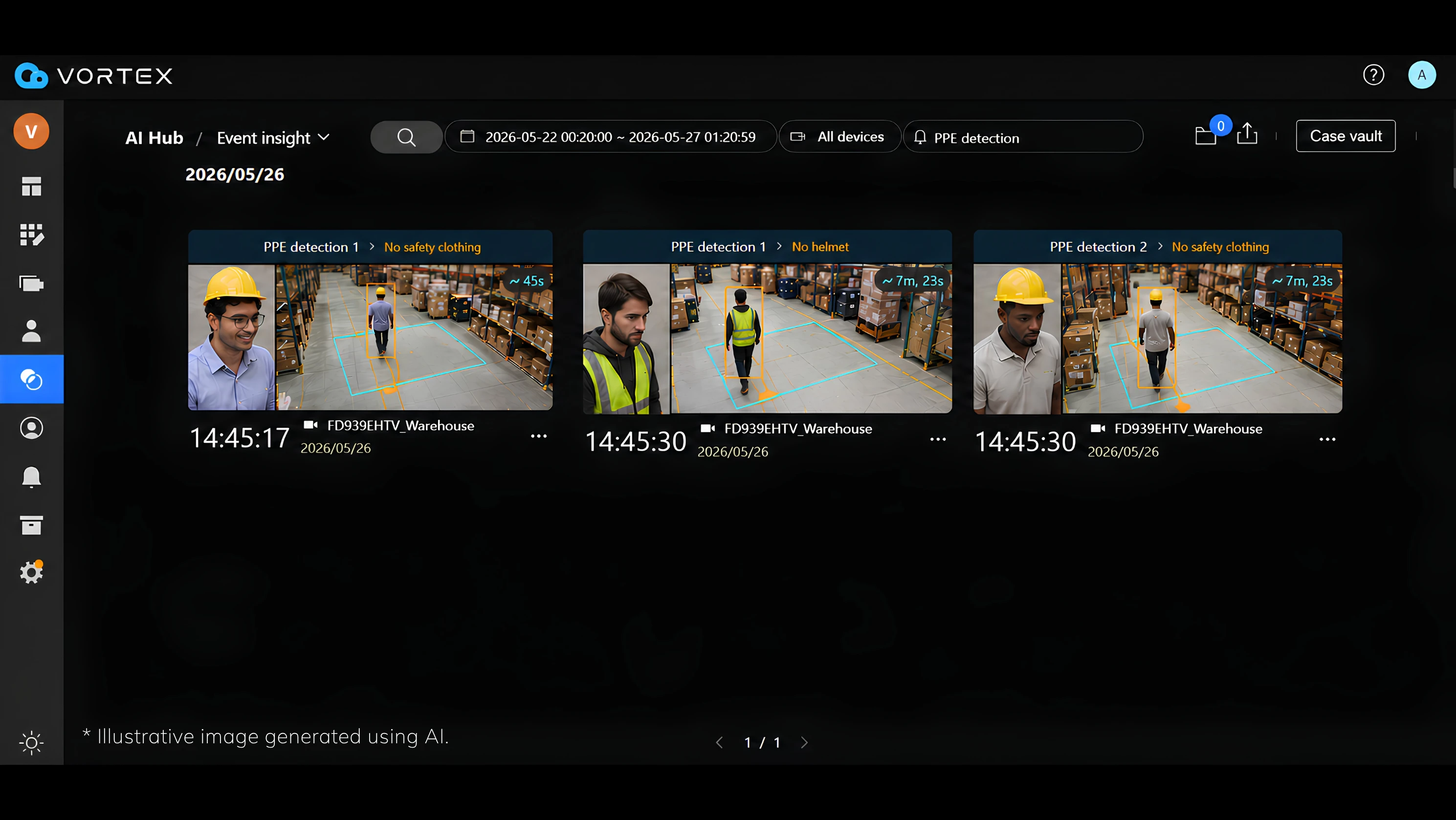
The Reporting stage relies on Case Vault and Re-Search within AI Hub, both of which require an xPro connection license. An xStd license supports the full Detect and Action stages, including real-time PPE Detection and automated Alarm Management responses. To unlock Case Vault evidence packaging and cross-camera Re-Search investigation, organizations must upgrade their connection license to xPro.
Where PPE Detection Delivers the Most Value
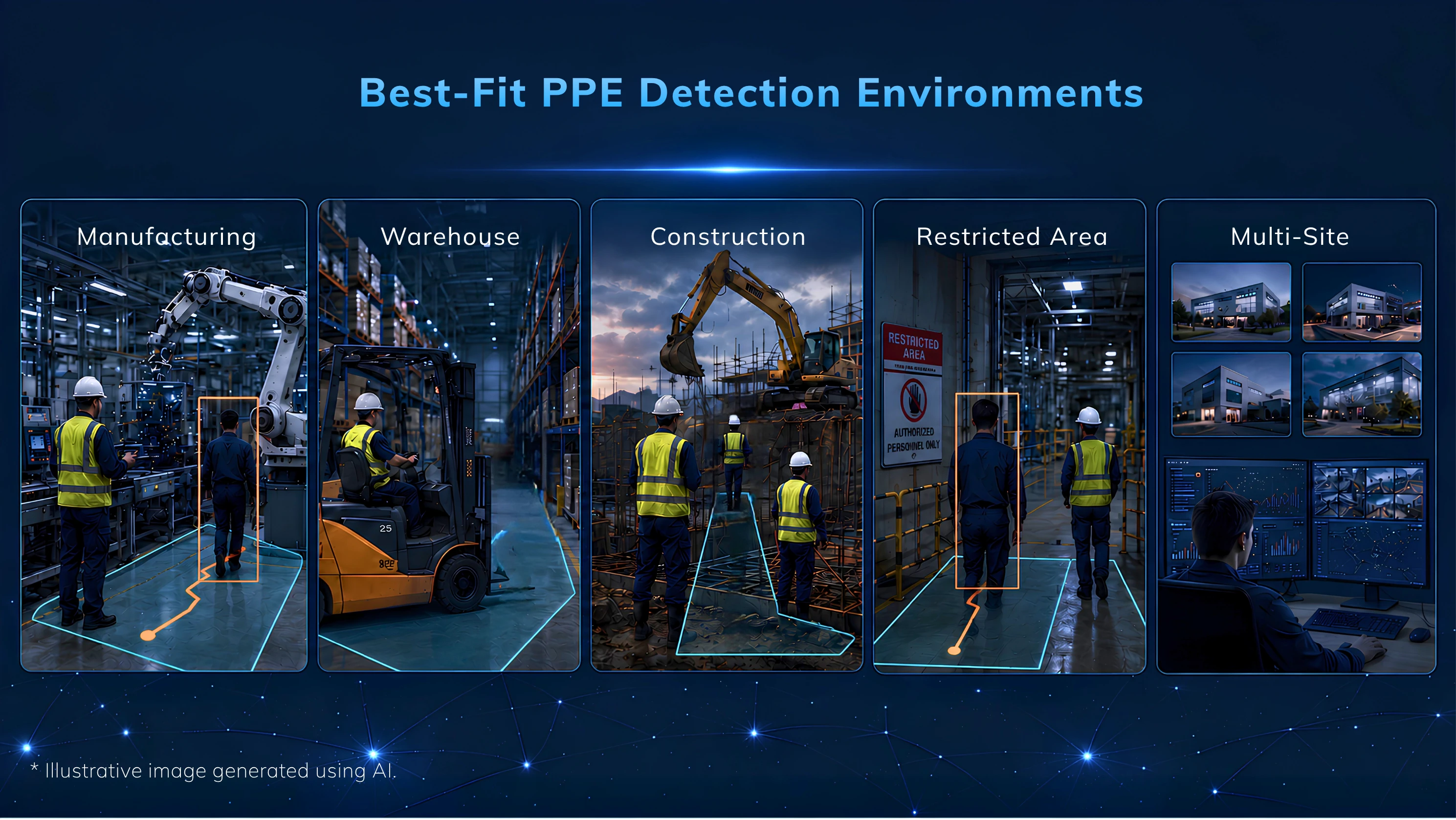
PPE detection is most valuable in high-risk environments where workers, vehicles, and equipment are in constant motion, and manual supervision cannot cover every area in real time. Common use cases include:
- Manufacturing and maintenance areas: Detect missing hard hats or safety vests around production lines, machinery, overhead work, and maintenance zones.
- Warehouses and logistics centers: Support safety vest detection near forklifts, vehicle lanes, loading docks, and other high-traffic areas where worker visibility is critical.
- Construction and industrial sites: Monitor dynamic work zones where contractors, workers, and equipment move throughout the day, helping safety teams catch PPE violations between manual walkthroughs.
- Restricted or high-risk areas: Trigger PPE violation alerts when workers enter designated zones without the required protective equipment.
- Multi-site operations: Centralize PPE compliance monitoring, event review, and safety reporting across multiple facilities.
By applying PPE detection in these scenarios, organizations can strengthen workplace safety monitoring, reduce response gaps, and build a more consistent approach to PPE compliance.
The Operational Impact of Continuous PPE Monitoring
Traditional safety monitoring depends heavily on manual patrols, periodic walkthroughs, and after-the-fact video review. These approaches are difficult to scale consistently across large facilities and multiple sites.
Across industry deployments, organizations that move from periodic manual checks to continuous, AI-based PPE monitoring report a consistent pattern of improvement. Violations decline as workers adjust to consistent, immediate feedback. Response times fall from hours—the gap until the next walkthrough—to minutes or less. Safety teams reclaim the hours previously spent watching monitors and walking rounds. And audit-ready reports that once took days of manual footage review can now be produced in minutes.
VORTEX brings these elements together into one workflow: detection that runs continuously, intervention that is triggered automatically through Alarm Management, and a reporting trail that holds up under audit. This is the difference between a system that documents your risk and one that helps reduce it.
Ready to Modernize Workplace Safety Operations
VORTEX Advanced AI helps organizations automate PPE detection, improve response times, and strengthen operational accountability across sites.
PPE Detection is part of the VORTEX Advanced AI service portfolio, which also includes capabilities such as Fall Detection and Think Alert for broader workplace safety and operational monitoring scenarios.
To learn more about additional Advanced AI services and applications, explore our related articles and solution resources.
Technical Prerequisites and Supported Camera Models
To use VORTEX PPE Detection, your VORTEX organization must operate a supported VORTEX camera model with an xStd or xPro connection license and the Advanced AI add-on license enabled.
▍ The following VORTEX camera models support PPE Detection:
-
Bullet: IB939-EHTV, IB839-EHTV-V2, IB833-HV
-
Dome: FD939-EHTV, FD839-EHTV-V2, FD833-HV
-
Turret: IT939-HTVW, IT839-HTVW-V2, IT833-HVW
-
Multi-Sensor: MS930-EHV
For organizations operating in global markets, workplace safety regulations and PPE enforcement expectations continue to evolve. The following public resources may help organizations understand regional PPE duties, workplace safety requirements, and compliance frameworks.
-
United States — OSHA PPE Standards & Penalties
-
Japan — Workplace Safety Duties and PPE-Related Ordinance
-
United Kingdom — Health and Safety Executive (HSE) Guidance at Work

Tags