文章摘要
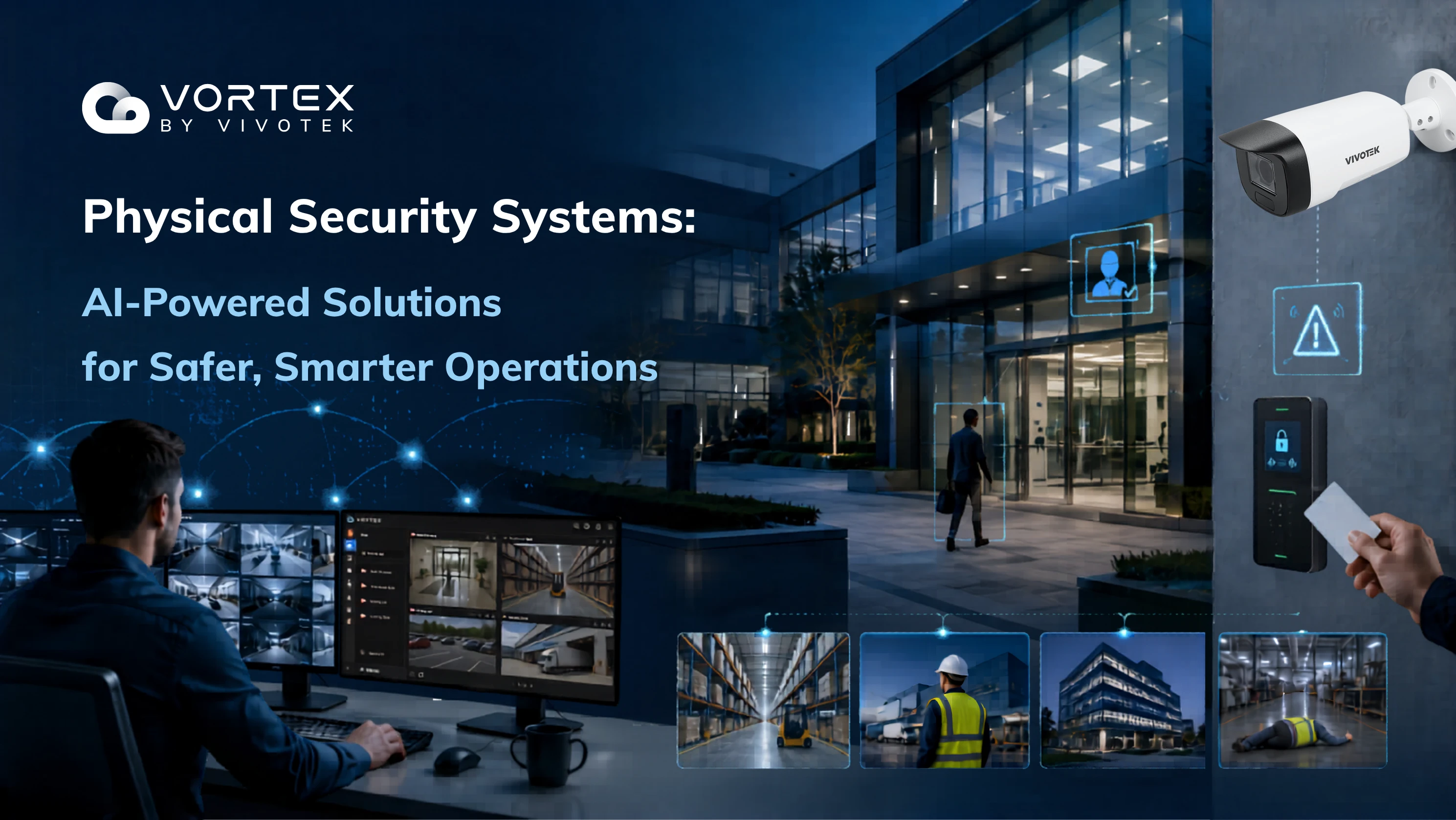
Physical security systems are no longer limited to cameras, alarms, and access control devices that simply record what happened. As businesses manage more sites, safety risks, compliance requirements, and operational threats, security teams need systems that can detect meaningful events in real time and help them respond before incidents escalate.
AI-powered security cameras, real-time detection, and no-code alert configuration are transforming physical security from passive surveillance into proactive risk prevention. From PPE detection and Fall detection to license plate recognition, sensor integration, and custom alerts powered by vision-language model technology, modern physical security helps organizations protect people, secure property, reduce operational risk, and improve efficiency across every site.
Why Traditional Physical Security Systems Are No Longer Enough?
Traditional physical security systems were designed around visibility and evidence. Cameras recorded videos, alarms notified teams when something was triggered, and security staff reviewed footage after an incident occurred. This model still has value, but it is no longer enough for today’s business environments.
The challenge is not simply whether a camera can record clearly. The bigger issue is whether the system can understand what is happening and alert the right people at the right time. In many organizations, large amounts of footage are never reviewed unless an incident is reported. Important events can be missed, alarms may lack context, and security teams can face alert fatigue when too many notifications are generated without clear priority.
This is especially difficult for businesses operating across multiple locations, such as factories, campuses, warehouses, retail stores, restaurants, parking areas, and residential properties. These environments need more than passive video recording. They need physical security systems that can detect risks, prioritize events, and support faster decisions.
That is why AI-powered physical security is becoming a critical part of modern safety and security operations. Instead of only helping teams review what happened, AI-powered cameras can help teams identify what is happening now.
What Makes an AI-Powered Physical Security System Different?
An AI-powered physical security system goes beyond basic motion detection. Traditional motion detection typically reacts when something moves in the frame. However, movement alone does not always indicate risk. A tree branch moving in the wind, a shadow, or a passing animal can all create unnecessary alerts.
AI-powered security cameras are designed to understand more meaningful visual information. They can help classify people, vehicles, objects, and specific behaviors. This allows security teams to focus on events that matter, such as:
-
A person entering a restricted area
-
A vehicle approaching a gate
-
A person falling in a monitored zone
-
A worker missing required protective equipment
 A modern AI-powered physical security system usually combines several layers:
-
Edge AI analyzes events close to where video is captured, supporting faster detection and reducing unnecessary data transfer.
-
Cloud-based management platform centralizes alerts, users, video access, reports, and multi-site operations.
-
Advanced AI capabilities, such as vision-language models, add more contextual understanding and support more flexible event definitions.
For example, VORTEX Advanced AI brings together AI-powered detection and operational workflows, including Think Alert, LPR, PPE Detection, and Fall Detection. This helps teams move from simple monitoring to a more proactive detect, act, and report process.
Real-Time Detection for Workplace Safety and Risk Prevention
Physical security is not only about preventing theft or unauthorized access. For many organizations, it is also closely connected to workplace safety, environmental health and safety, compliance, and operational risk management.
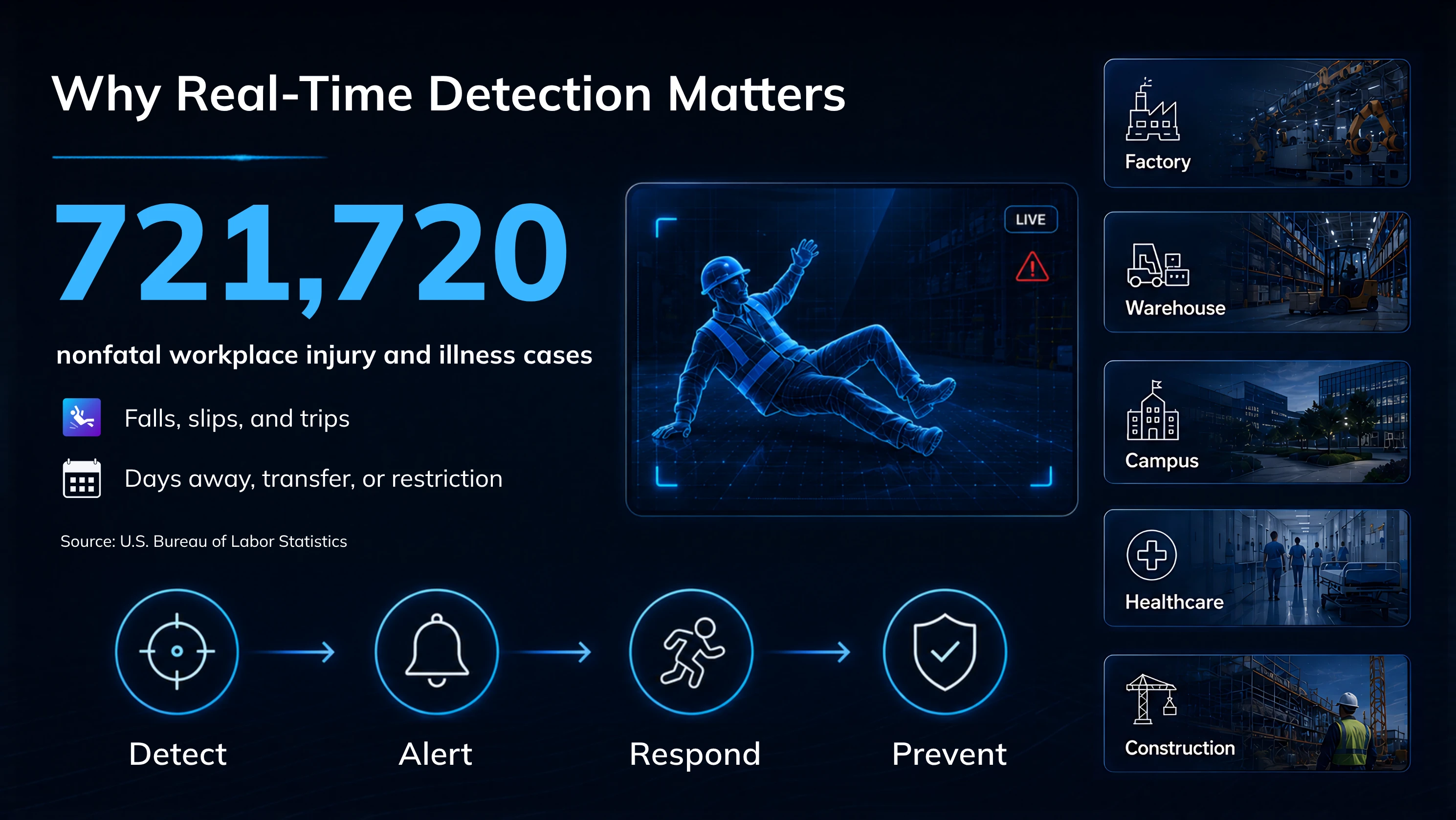
According to the U.S. Bureau of Labor Statistics, falls, slips, and trips accounted for 721,720 nonfatal workplace injury and illness cases involving days away from work, job transfer, or restriction in 2023–2024. For businesses managing factories, warehouses, campuses, healthcare facilities, construction areas, and other high-risk environments, this highlights why real-time detection and faster response are becoming important parts of workplace safety programs.
This is where real-time AI detection becomes valuable. Instead of relying only on manual patrols, after-the-fact reporting, or wearable devices, AI-powered cameras can provide an additional layer of visibility across critical areas.
Fall Detection for Faster Emergency Response
Falls can happen in many environments, including senior living facilities, healthcare spaces, warehouses, factories, campuses, and public areas. When a person falls and cannot call for help immediately, every minute matters.
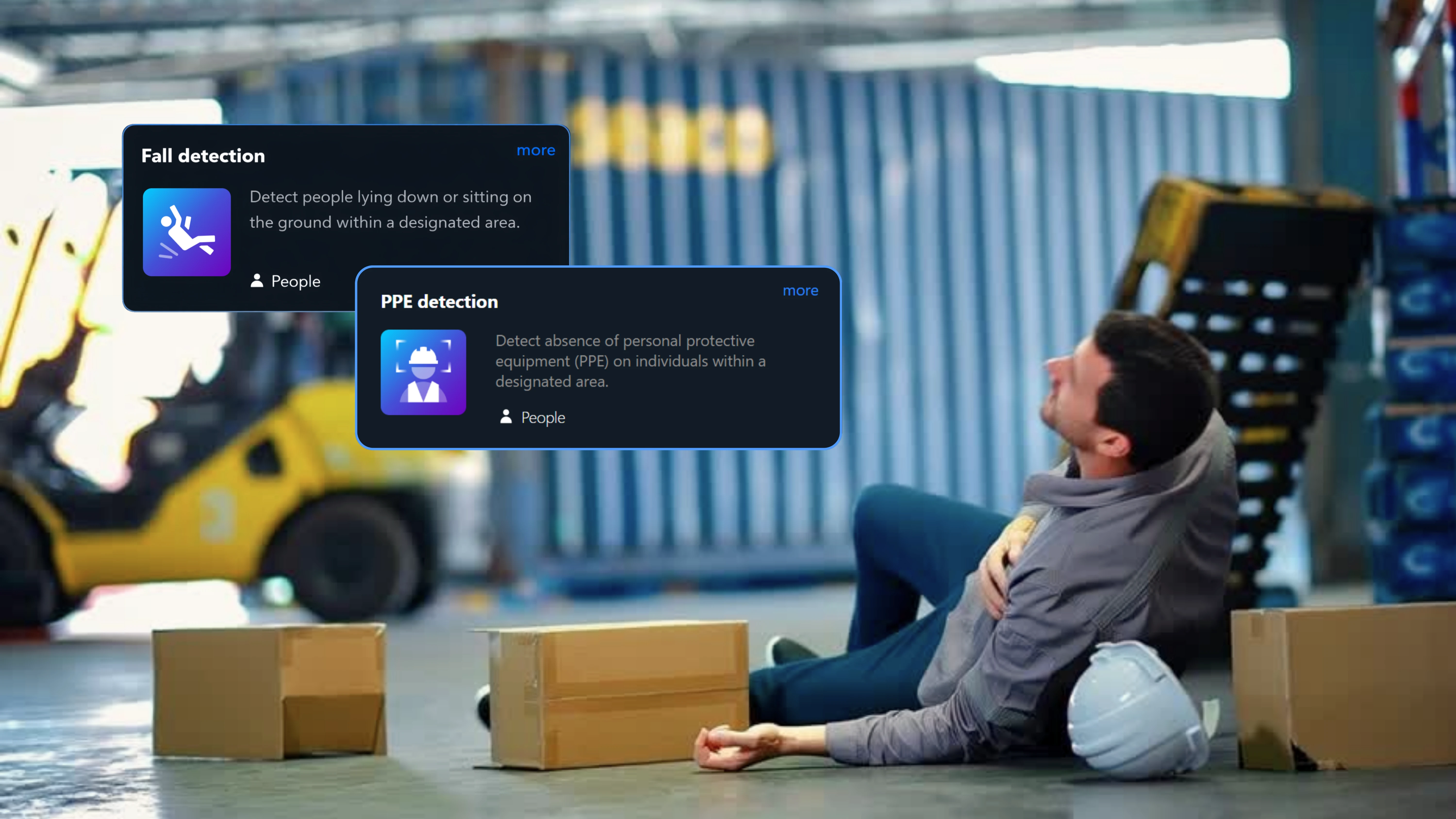
AI-powered fall detection can help identify when a person falls, collapses, or remains on the ground in a monitored area. Once detected, the system can trigger alerts to notify responsible teams through cloud-based workflows, helping staff respond faster and reduce the risk of delayed assistance.
This does not replace human judgment. Instead, fall detection gives safety and security teams an additional layer of awareness, especially in areas that cannot be monitored continuously by staff. For organizations managing vulnerable populations, large facilities, or high-risk work zones, this can support faster emergency response and better incident documentation.
PPE Detection for Safer and More Compliant Workplaces
In industrial, construction, warehouse, and manufacturing environments, personal protective equipment is a basic but critical part of safety management. Helmets, safety vests, gloves, goggles, and other protective equipment help reduce exposure to workplace hazards. However, safety compliance can be difficult to monitor consistently across busy or distributed sites.
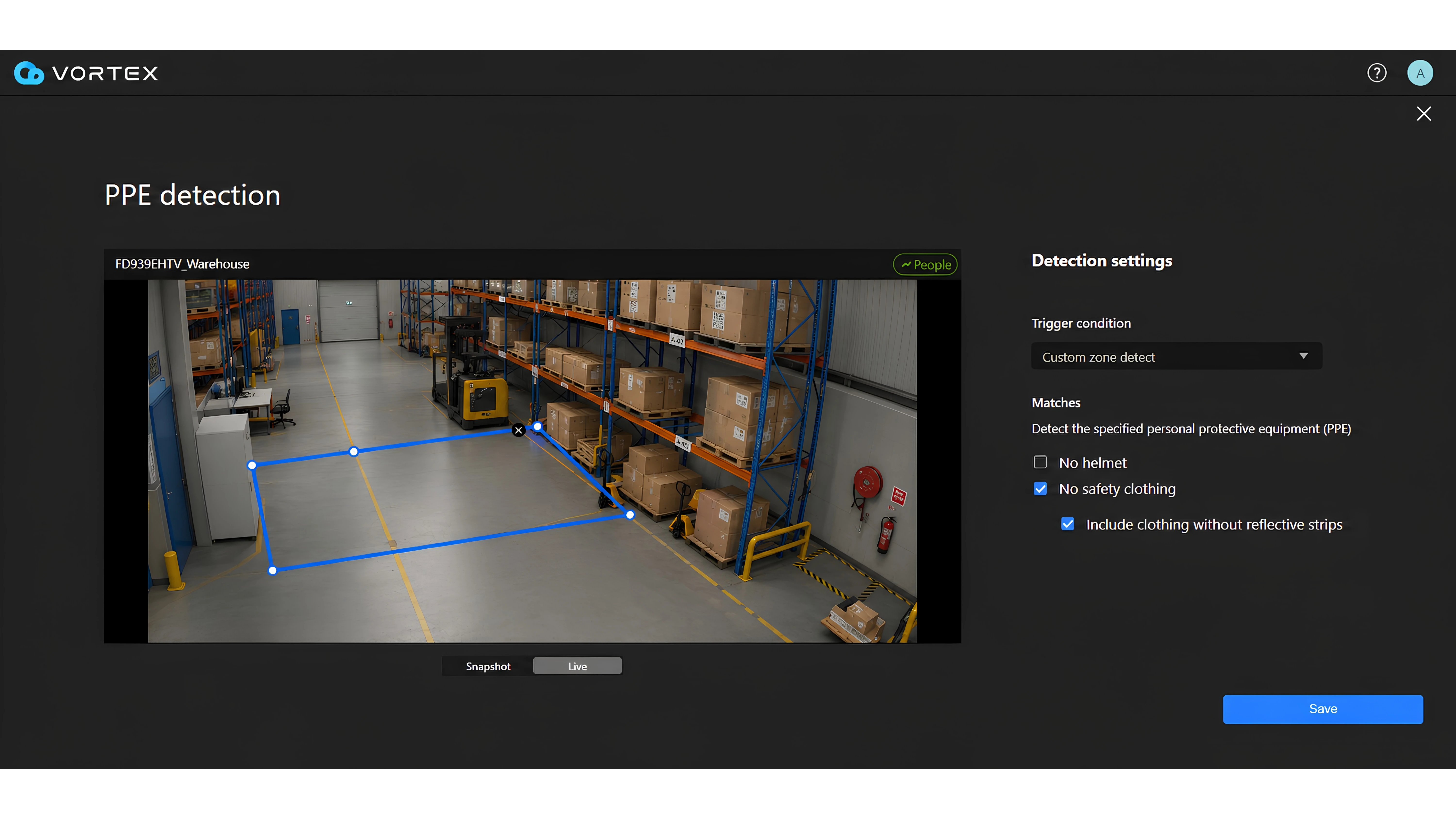
PPE detection helps safety teams identify whether workers are wearing required protective equipment in monitored areas. For example, AI-powered cameras can help detect whether a worker is missing a helmet or safety vest before entering a high-risk zone.
This gives safety officers more visibility without adding more manual inspection burden. Instead of reviewing footage after an incident, teams can receive alerts when a potential violation occurs and respond before the risk escalates. Over time, these event records can also support safety audits, incident reviews, and compliance reporting. For example, VORTEX Cloud Video Surveillance supports PPE violation detection for helmets and safety vests, with real-time alerts and cloud-based compliance audit reports that can help teams review incidents and improve workplace safety management.
From Fixed Rules to No-Code Alerts with VLM-Powered Think Alert
Traditional video analytics often depend on predefined categories, such as motion detection, line crossing, intrusion detection, loitering, or object detection. These rules are useful, but real-world risks are often more specific and contextual.
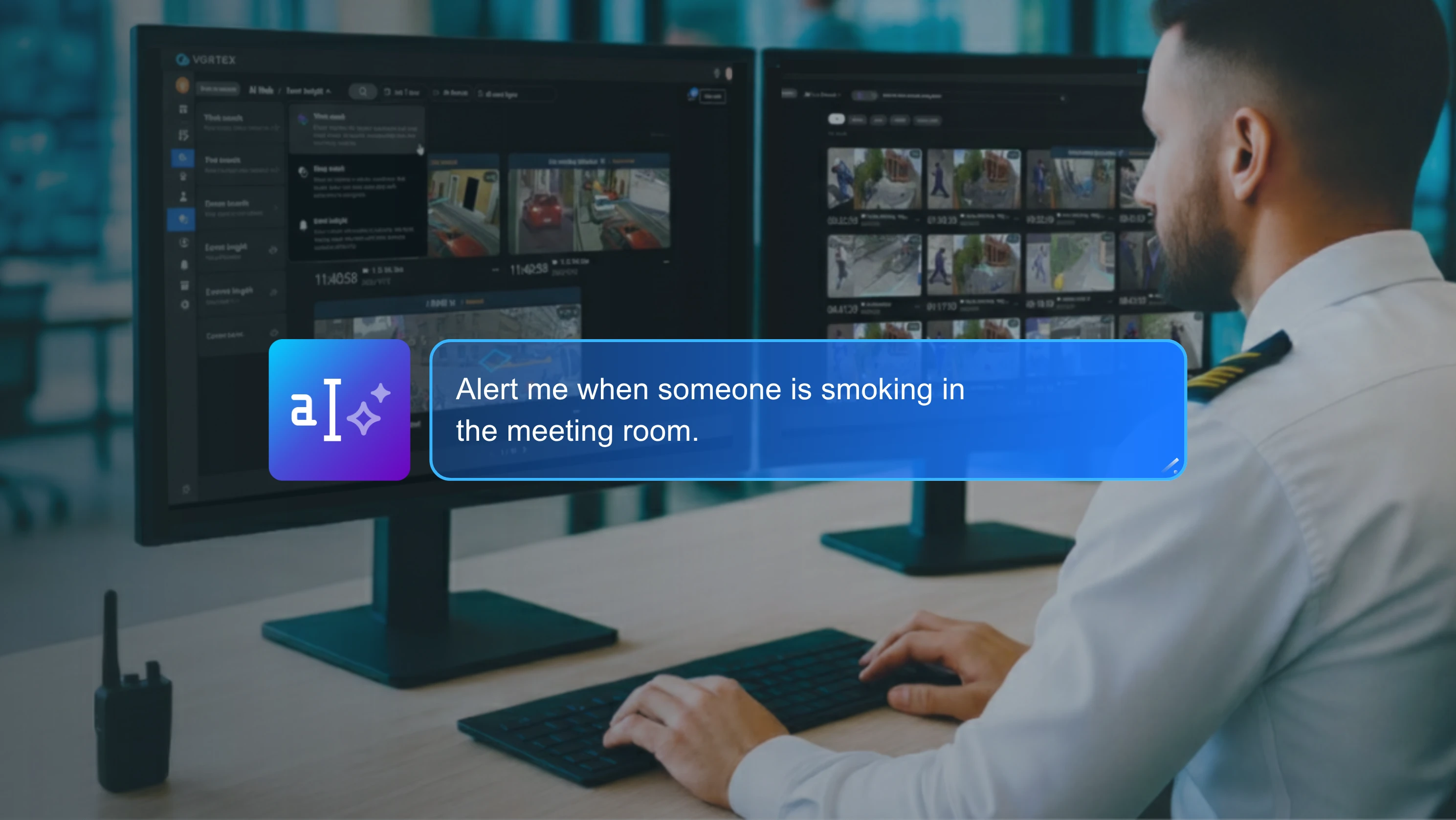
A business may not only want to know that “a person entered an area.” It may want to know whether a worker without a helmet entered a construction zone, whether someone is smoking in a restricted area, whether a person entered a loading dock after hours, or whether a passenger vehicle entered a logistics-only lane.
This is where VLM-powered Think Alert changes the way security teams configure alerts. Instead of relying only on preset rule categories or complex configuration, Think Alert allows users to describe what they want to detect using natural language and create custom alert scenarios that better match real operational risks.
Industry media outlet Dark Reading notes that vision-language models can help physical security teams reduce alert fatigue by adding real-time context to alarms and enabling natural-language interaction with video. This supports the same shift enabled by Think Alert: moving from rigid preset rules to more flexible, context-aware alert workflows.
With no-code alert configuration, teams can adapt rules more easily as operational risks change, helping them move from passive monitoring to more proactive, site-specific alert workflows.
Integrated Security Management: Connecting Cameras, Access Control, LPR, and Sensors
Modern physical security also depends on how different systems work together. Security risks do not only happen in front of a camera. They can involve door access events, vehicle entries, environmental changes, sensor triggers, alarms, or activity across multiple areas of a site.
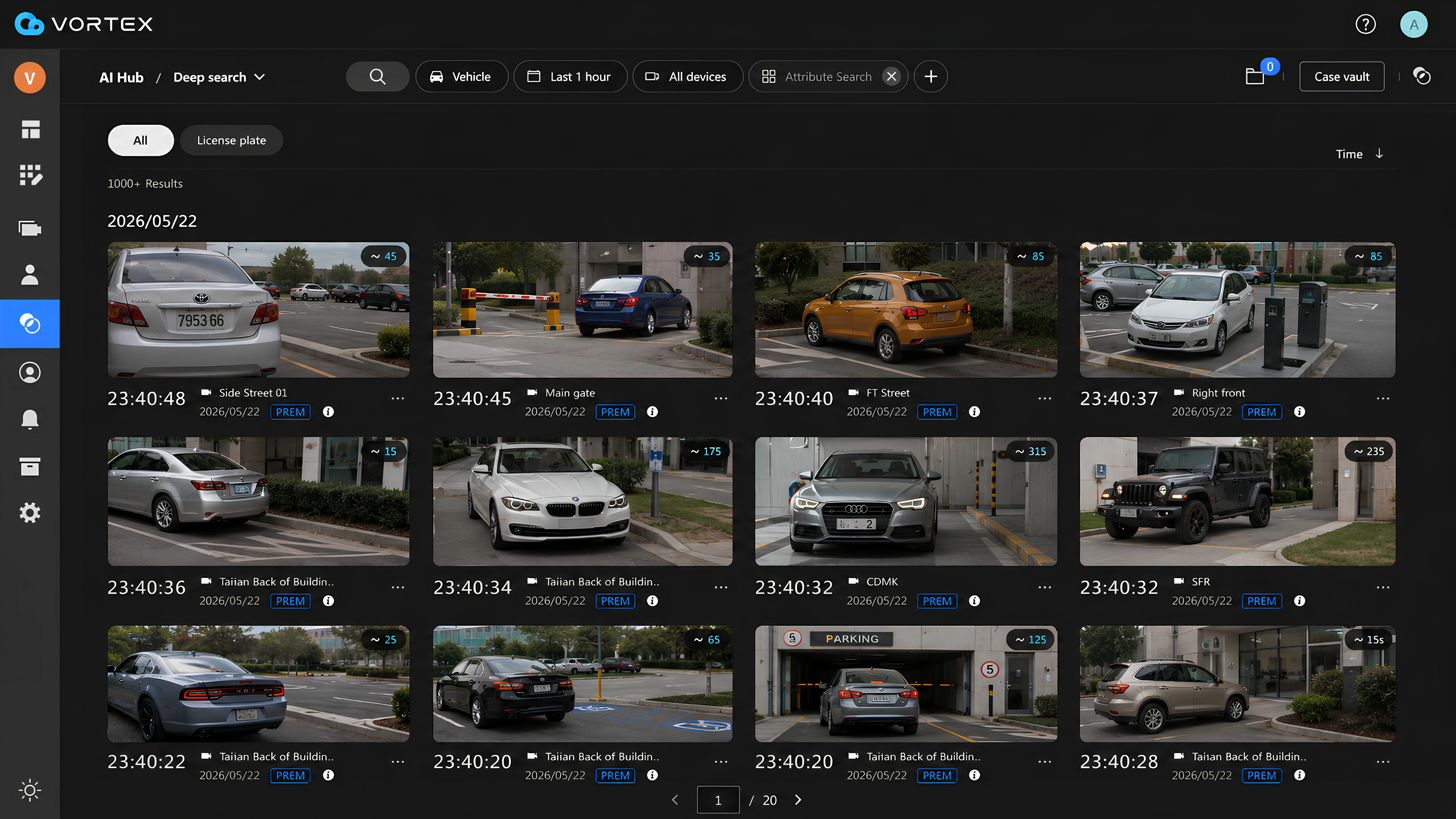
By integrating cameras with access control, LPR, sensors, and other security devices, organizations can create a more complete picture of each event. For example, a door forced-open alert can be paired with video verification. A vehicle entering after hours can be checked against LPR records. A sensor-triggered event can automatically pull up the nearest camera view or trigger an on-site warning through a connected speaker.
This type of integrated security management helps teams move beyond isolated alerts. Instead of checking separate systems one by one, security teams can connect visual evidence, access records, sensor data, and alert workflows in one place. This improves incident verification, speeds up response, and supports more consistent security operations across sites.
Access control and LPR are especially useful for managing how people and vehicles move through a property. Facial recognition may also support identity-aware security in specific use cases, but it should be deployed carefully and only where permitted by local regulations and internal privacy policies.
For most organizations, the goal is not to add more disconnected tools. It is to connect cameras, alerts, sensors, access events, and operational workflows into a more complete physical security system.
Edge AI and Cloud Management for Multi-Site Physical Security
The strongest AI-powered physical security systems do not rely on only one layer of intelligence. They combine edge AI and cloud-based management to balance speed, scalability, and operational control.
Edge AI processes events close to the camera. This helps reduce latency, supports faster alerts, and can reduce unnecessary data transfer. For real-time detection use cases such as intrusion, PPE violations, or fall incidents, fast local analysis can be important.
Cloud management is equally important because security operations rarely happen around a single camera. Teams need to manage users, alerts, reports, devices, permissions, and incident reviews across multiple locations. The cloud makes it easier to standardize workflows, deploy updates, access video remotely, and coordinate response across distributed teams.
For multi-site organizations, this centralized approach helps reduce operational silos. Instead of switching between different cameras, recorders, access control systems, and reporting tools at each location, teams can access video, review events, configure alerts, and generate reports through a unified platform.
Together, edge AI and cloud-based workflows help organizations build a physical security system that is both responsive and scalable. Edge AI helps detect what is happening now, while the cloud helps teams manage what happens next.
Compliance, Privacy, and Responsible AI Security
As AI becomes more common in physical security systems, organizations also need to think carefully about compliance, privacy, and governance. Faster detection is valuable, but it must be managed responsibly.
For workplace safety and EHS programs, AI-powered event records can support incident documentation, safety audits, and compliance review. These records can help teams understand what happened, identify recurring risks, and improve safety policies over time.
Organizations should also define clear policies for how video data is collected, accessed, stored, and reviewed. This is especially important when using technologies related to identity, such as facial recognition, access control logs, or visitor tracking.
A responsible AI security strategy should include clear user permissions, retention policies, audit trails, encryption, and transparent internal guidelines. The goal is not only to improve security, but to build trust. When AI-powered physical security is deployed responsibly, it can help organizations improve safety and efficiency while maintaining appropriate oversight and accountability.
Building a Future-Ready Physical Security Strategy
A future-ready physical security strategy should not only ask whether cameras can record clearly. It should ask whether the system can detect risks in real time, adapt alerts to each site, support workplace safety, integrate with access and vehicle management, and centralize operations across every location.
This is a major shift from traditional surveillance. The value of physical security is no longer limited to what teams can review after an incident. It is increasingly defined by how quickly teams can detect risk, understand context, take action, and document what happened.
AI-powered cameras make this shift possible. Fall detection can support faster emergency response. PPE detection can strengthen workplace safety and compliance. LPR and access control integration can improve visibility over people and vehicles. Think Alert can help teams create custom alerts in natural language, turning site-specific risks into proactive workflows.
For modern businesses, physical security is becoming more than a protective layer. It is becoming part of operational intelligence. With the right combination of AI detection, cloud-based management, and responsible governance, organizations can move beyond passive surveillance and build safer, smarter, and more efficient operations.
Move Beyond Passive Surveillance with VORTEX
Modern physical security is no longer just about recording what happened. With AI-powered detection, no-code alert configuration, and cloud-based management, VORTEX helps organizations detect risks earlier, respond faster, and manage security more efficiently across every site.
Explore how VORTEX can help you build a smarter, more proactive physical security system. 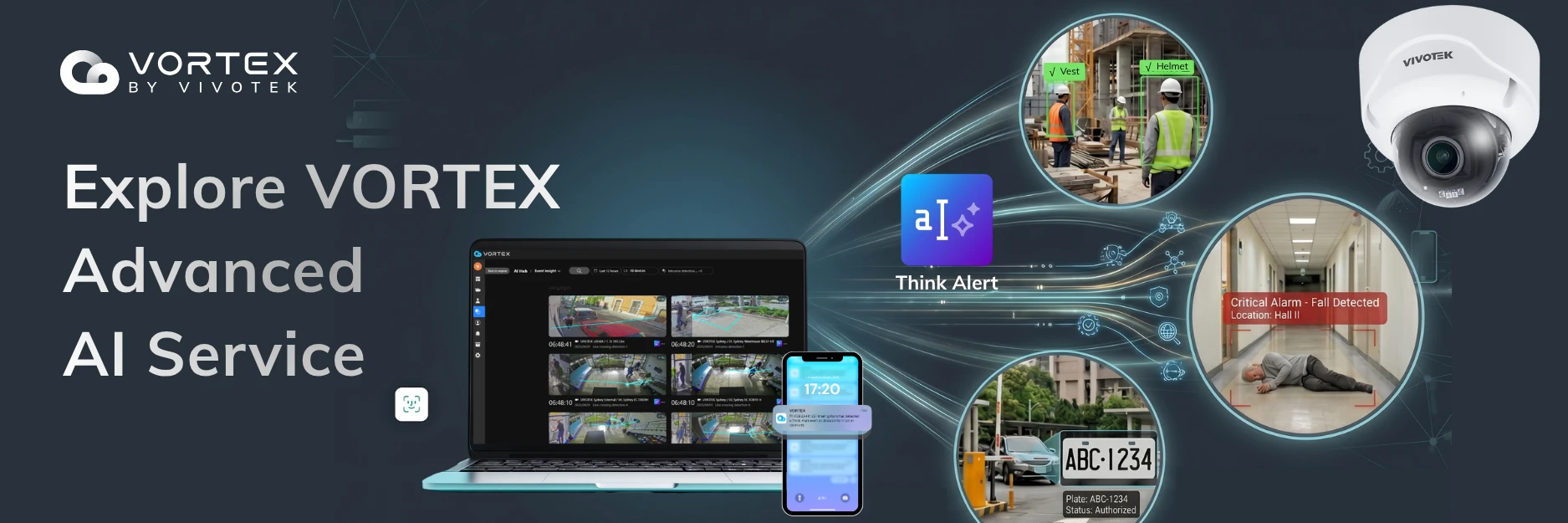
- What is a physical security system?
A physical security system is a combination of technologies, policies, and processes designed to protect people, property, facilities, and operations. It may include security cameras, access control, alarms, sensors, video management systems, and AI-powered detection tools. - How do AI-powered cameras improve physical security?
AI-powered cameras improve physical security by helping teams detect meaningful events in real time. Instead of only recording video, they can identify people, vehicles, objects, behaviors, PPE violations, falls, and other risks that require attention. - What is the difference between motion detection and real-time AI detection?
Motion detection reacts when movement appears in the video frame. Real-time AI detection goes further by analyzing what is moving, what type of object or person is involved, and whether the event matches a meaningful risk scenario. - How does PPE detection support workplace safety?
PPE detection helps identify whether workers are wearing required protective equipment, such as helmets or safety vests, in monitored areas. This can help safety teams respond to potential violations faster and support workplace safety audits. - How does fall detection work in a physical security system?
Fall detection uses AI video analytics to identify when a person falls, collapses, or remains on the ground in a monitored area. When a potential fall is detected, the system can send alerts to help teams respond faster. - What are no-code alerts in physical security?
No-code alerts allow users to define custom alert scenarios without programming. With VLM-powered tools such as Think Alert, teams can describe what they want to detect using natural language and create more flexible, site-specific alert workflows.