Table of Contents
 Property management security systems have shifted from “record and review later” to “detect and respond now”—especially for multi-site property managers balancing tenant safety, operating costs, and liability risk.
In the U.S., the FBI’s latest national estimates report 5,986,400 property crime offenses in 2024, underscoring why portfolios need proactive detection, faster incident response, and consistent oversight across sites.
AI-powered, cloud-enabled surveillance is becoming one of the most effective AI security solutions for property management, helping teams detect critical events faster, reduce false alarms, and manage multiple properties without adding headcount.
Why Security Matters for Property Managers Across Multi-Site and Residential Buildings
For property managers, security is not just a safety expense—it directly impacts tenant retention, reputation, insurance claims, and staff workload. A single incident can trigger complaint escalations, disputes, or recurring issues across a portfolio.
The hidden cost is operational: when teams must travel on-site, manually verify alarms, and spend hours searching for footage, security becomes an everyday tax on leasing, maintenance, and service quality.
Key Physical Security Challenges in Multi-Family, Commercial, and Multi-Site Properties
Multi-site property operations often face the same threat patterns, but priorities differ by environment:
-
Multi-family / residential communities
Package theft, unauthorized access, loitering near entrances, tailgating through secure doors, and after-hours activity in shared spaces are common daily issues. -
Commercial buildings
Higher traffic variability, vendor/contractor movements, and restricted-zone compliance (e.g., loading docks, service corridors) require better control and auditable incident records. -
Distributed multi-site portfolios
The biggest challenge is fragmentation: siloed systems by site, inconsistent procedures, and delayed response due to manual review. Traditional approaches—guards, basic CCTV, and on-prem systems—don’t scale when teams must manage dozens of sites.
To address these challenges, modern property management security systems need to provide comprehensive visibility across the entire property while enabling faster incident response. By combining cameras, centralized monitoring, and AI-driven detection, security teams can monitor key areas—from parking lots and building entrances to elevators, hallways, and shared spaces—ensuring consistent protection across multi-site environments.
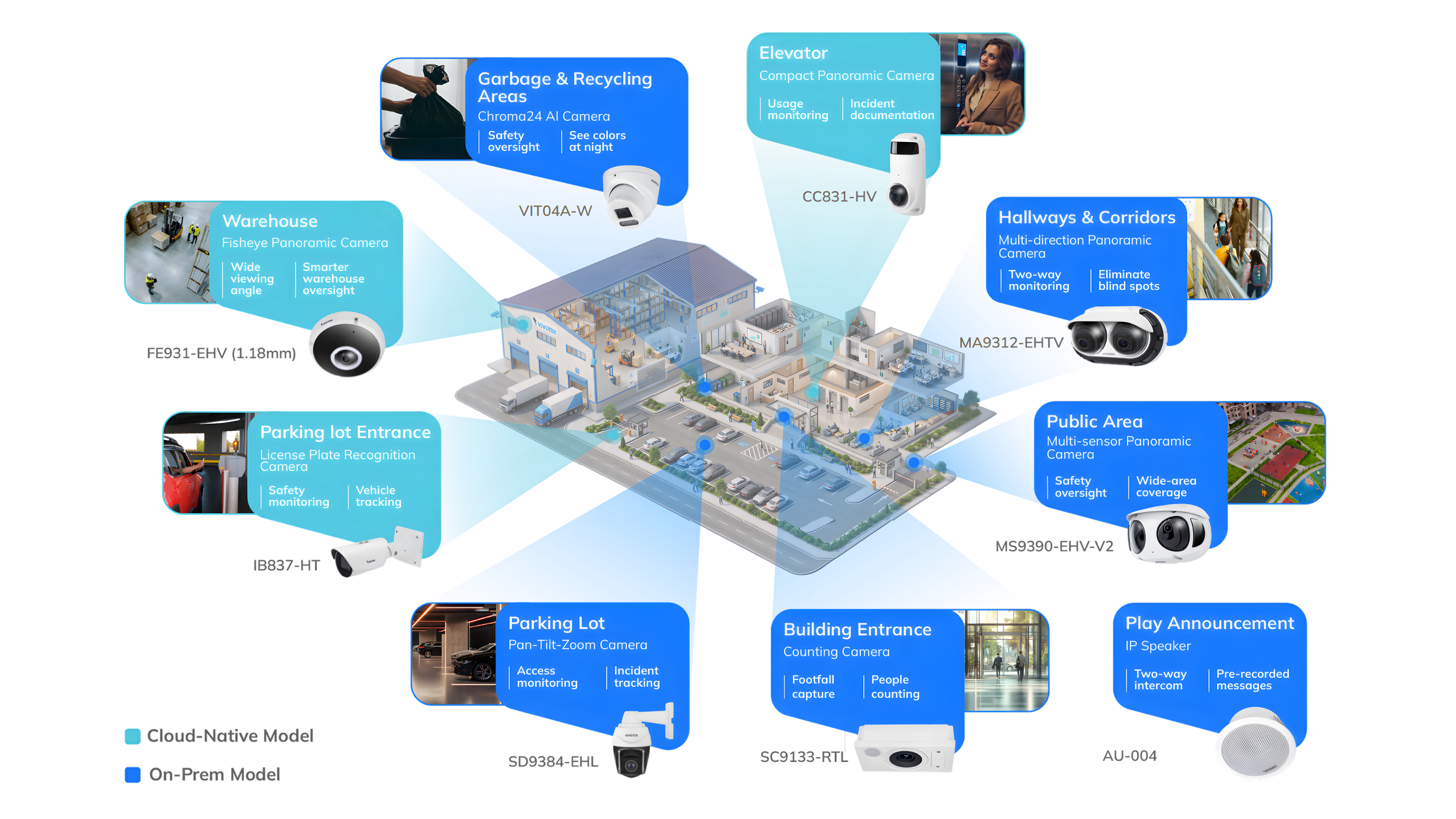
Protecting multiple areas across a property requires more than just adding cameras—it requires the right strategy for every zone. From entrances and parking lots to elevators, hallways, and shared spaces, each area has different security needs.
Download our latest free eBook, The Smarter Way to Protect Every Corner of Your Property, to discover a practical zone-by-zone roadmap for smarter property security, including camera placement guidance, AI monitoring benefits, and strategies to improve operations without replacing your existing system.

The Role of Surveillance, Monitoring & Incident Review in Property Management
Surveillance shouldn’t be “record now, investigate later.” Modern property operations need active monitoring—real-time alerts that help staff react before situations escalate.
Incident review is equally operational:
-
Insurance claims and liability disputes require timestamped video evidence and clear documentation.
-
Post-incident analysis helps prevent repeat issues, refine patrol schedules, and strengthen access policies.
When surveillance becomes searchable and shareable across teams, it also supports day-to-day workflows—like verifying vendor access after-hours or confirming activity during maintenance windows.
The Traditional Security Approach: Gaps and Limitations
Traditional methods create predictable bottlenecks:
-
Guards can’t cover everywhere and inevitably miss short windows.
-
Basic CCTV is reactive-only, hard to search, and not designed for prevention.
-
Siloed site-by-site systems create blind spots across portfolios.
-
Manual review delays response by hours or days.
For property managers, this usually shows up as: “We have cameras, but we still don’t know what happened until it’s too late.”
How AI Transforms Property Management Security Systems: From Reactive to Proactive?
AI security solutions for property management change the security model by focusing attention on what matters. Instead of watching everything, teams receive alerts for high-signal events—like loitering near a package room, tailgating through a secure entrance, or after-hours movement in restricted zones.
This matters because AI can reduce false alerts by up to 90% in some deployments, letting staff spend less time filtering noise and more time responding to real risks.
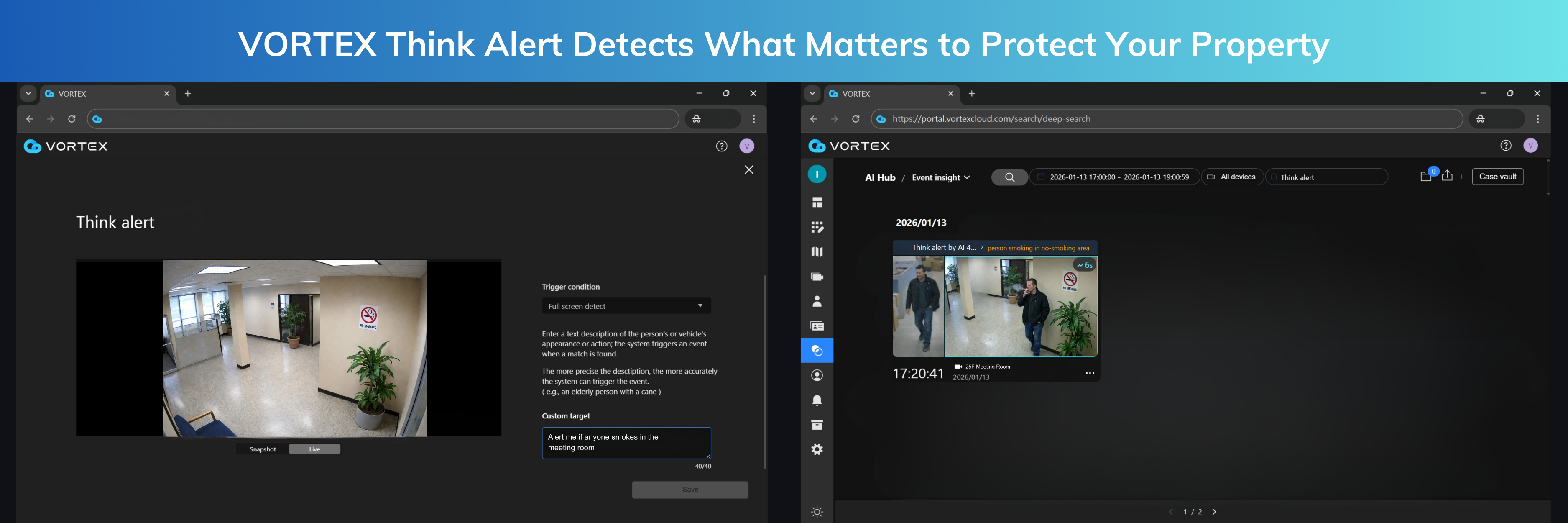
For example, VORTEX Think Alert is a VORTEX AI feature that can be applied to property management security systems, allowing property managers to define exactly what behaviors or events they want the system to detect. By simply describing the scenario to monitor—such as detecting someone smoking in a no-smoking area, as shown in the image below—the system can automatically trigger alerts when the specified condition is detected. This transforms surveillance from passive recording into a proactive security tool that helps protect properties more effectively.
|Comparison Table:
How Centralized Cloud-Based Security Improves Operational Efficiency for Multi-Site Portfolios
For multi-site property managers, the real breakthrough is centralized visibility—monitoring many properties from one place, with fewer site visits and fewer manual checks. The operational value shows up in a few practical capabilities:
-
Centralized multi-site management + remote device management reduces the need for IT expertise on-site.
-
AI-powered deep search or Generative AI VLM search helps teams locate critical moments quickly (e.g., track a suspicious vehicle’s path or find a specific incident).
-
Automated firmware/OTA updates mean fewer maintenance trips and less downtime.
-
Bridge-to-cloud integration connects existing cameras without requiring a full hardware replacement, making upgrades easier across older buildings.
Privacy, Compliance, and Tenant Trust: How to Deploy AI Surveillance Responsibly
In residential and mixed-use buildings, AI solutions for security and compliance in property management must balance safety with tenant trust. That’s why privacy and compliance must be designed in, not added later.
A practical approach is to align with privacy-first best practices such as:
-
privacy-by-design architecture
-
clear data retention & deletion policies
-
transparent consent at move-in
-
role-based access for staff
-
encryption in storage and transmission
-
regular audits
Your policy details will vary by region and use case, but the principle is universal: the more transparent and controlled your surveillance program is, the more trust you earn—and the smoother your operations become.
What “Good” Looks Like: A Practical Checklist for Property Management Security Systems
If you’re evaluating AI solutions for security and compliance in property management (or upgrading from legacy CCTV), look for these property-manager-friendly capabilities:
-
Portfolio visibility: one dashboard for all sites (not site-by-site logins).
-
Actionable AI alerts: intrusion, loitering, crowding, restricted access—without constant false alarms.
-
Fast investigation: deep search / meta-tagging to pinpoint incidents quickly.
-
Remote operations: OTA updates + remote device management to reduce site visits.
-
Hybrid readiness: connect new or existing cameras and scale across different layouts and legacy systems.
For multi-site property managers, modern security is about portfolio visibility, faster response, and consistent governance—not just adding more cameras. If you’re managing multiple properties and want to reduce false alarms, speed up investigations, and simplify operations, explore VIVOTEK’s solutions for property management and see what a unified, AI-powered hybrid cloud platform can do.
Results in the Field: Examples from VORTEX Deployments
American Veterans Security (AVS):
AVS struggled with hundreds of false alarms nightly. With VORTEX, they reported false alarms were reduced by up to 90% and savings up to $2,000 per installation, helping avoid frequent maintenance calls.
Large-scale multi-site oversight:
Another portfolio snapshot highlights centralized management for 24,000+ apartments across 28 states, improving oversight efficiency through centralized and remote management.
To explore more real-world examples of AI security solutions for property management, download our Property Management Security eBook and discover best practices for managing multi-site portfolios more efficiently.
Download the ebook: Transform Your Property Management Security Strategy with Edge AI
-
What are AI security solutions for property management?
AI security solutions use video analytics to detect high-risk events (e.g., loitering, intrusion, restricted access) and send actionable alerts so teams can respond faster. -
How does cloud-based surveillance work for multi-site properties?
A cloud/hybrid platform consolidates cameras, alerts, and evidence across sites into a centralized dashboard, enabling remote monitoring and management. -
Can AI security systems integrate with my existing cameras?
Yes—hybrid architectures can connect new or existing cameras, helping older buildings upgrade without a full replacement. -
What privacy laws apply to AI surveillance in residential buildings?
Requirements vary by jurisdiction; teams should follow privacy-first best practices like access controls, encryption, and clear retention policies. -
Is AI-powered security more cost-effective than traditional guard services?
It can be—especially when AI reduces false alarms and cuts investigation time.

Tags